Want Better Creative Ideas? Stop Trying to Solve the Problem

I’m heavily into editing a feature film at the moment, and I’m trying to remind myself of something I seem to forget every time I make a film:
my job is not always to find the solution.
sometimes my job is just to find the problem.
Sounds obvious. But it’s surprisingly difficult in practice.
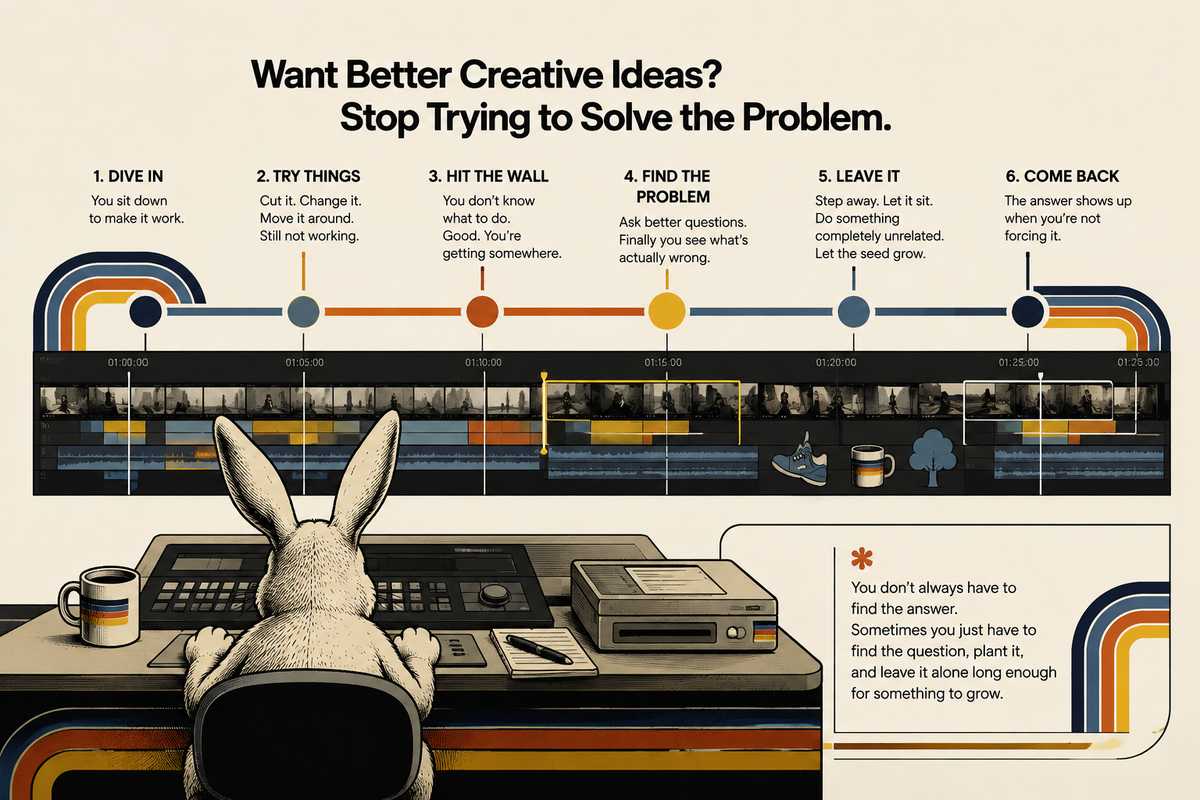
I sit down to edit a scene and immediately want to make it work. That’s what we do, right - solve problems.
The scene feels too long, so I shorten it. Still doesn’t work.
Maybe it’s the performance. I change takes - - still not working.
Maybe I move something around… nothing.
And eventually something much more useful happens - I hit a wall - I don’t know what to do.
I used to think this was the frustrating part of creative work. Now I’m beginning to think it might actually be one of the most important parts. Because if I can just tolerate not knowing the answer for a little while, I start asking better questions. Maybe the problem isn’t the length of the scene. Maybe it’s not even in this scene.
Maybe we gave the audience information too early, or the character knows something they shouldn’t know yet. Maybe I’m protecting a beautiful shot because… well, it’s a beautiful shot. Maybe the whole scene is trying to do something the film simply doesn’t need.
And now I have something. I found the problem. And lately I’m starting to think - that can be enough work for one session. I don’t necessarily have to solve it.
Actually, sometimes trying to solve it immediately seems to make things worse. Because there’s this temptation once you find the problem to keep digging. One more cut. Another version. Try this.
-- another hour.
So I’m trying something different. Find the problem - and leave.
Make coffee. Go to the gym. Pick up my daughter. Walk somewhere. Do something completely unrelated to the film. Just let the problem sit there.
Psychologists have a term for some of this: incubation. Research into creative problem-solving suggests that stepping away from a problem can help us return with new ideas. The mind seems to keep doing something even when we’re no longer consciously wrestling with it. But I know this less from psychology and more from filmmaking.
You leave the editing room with absolutely no answer.
Then twenty minutes later you’re doing something completely unrelated and -
of course.
There it is.
I sometimes think of these creative problems as planting seeds.
Not brilliant ideas. Not solutions - problems.
A question I can’t answer. A scene I don’t understand. Something that feels wrong, but now at least I understand why it feels wrong. That’s the seed.
And once it’s there, maybe the worst thing I can do is keep digging it up every five minutes to see if anything has grown.
Leave it in the ground. Let some time pass. Let the attention go somewhere else.
let the sun do its thing. Then come back. Of course I’m terrible at following this consistently. I’ll decide I’m finished and then notice one tiny cut. I fix the cut, which exposes another problem, so I fix that… and suddenly the edit has annexed another hour of my day.
But this is the principle I’m trying to follow while editing this film:
get into trouble - then have the audacity to wait.
Go looking for the wall. Find the thing you don’t understand. Be vulnerable enough to admit -
I don’t know how to fix this.
And then, sometimes, stop.
Because discovering a problem isn’t necessarily a failure of the creative process.
it may be the creative process.
You don’t always have to find the answer.
Sometimes you just have to find the question, plant it…
and leave it alone long enough for something to grow.