Taming The Elephant: The Inner Critic’s No-Win Loop When Selecting Creative Task
... and not before long, the same voice returns with a different complaint: "You’re not moving fast enough."


In an early Buddhist discourse, training the mind is compared to taming a wild elephant. The trainer brings the elephant out of the forest, tethers it to a strong post, speaks to it gently, gives it food and water, and teaches it one simple movement at a time. The point is not to overpower such a strong animal in one heroic struggle, but to give its restless energy something steady to return to. My inner critic often feels like that elephant—powerful, agitated, and forever circling the agreement I have made, looking for a way to pull free. I am learning not to fight it or obey it, but to give it a post: one small promise, chosen before I begin, that remains fixed when the criticism starts.
There are days when I really want to work on my book. The energy is there, the ideas feel alive, and I want to follow them.
But another voice immediately appears: You should be editing.
So I edit. And before long, the same voice returns with a different complaint: You’re not moving fast enough.
That is the inner critic’s favorite trick. It doesn’t simply enforce a demanding rule—it changes the rule depending on what I choose. If I write, I should have edited. If I edit, I should have accomplished more. Either way, I lose.
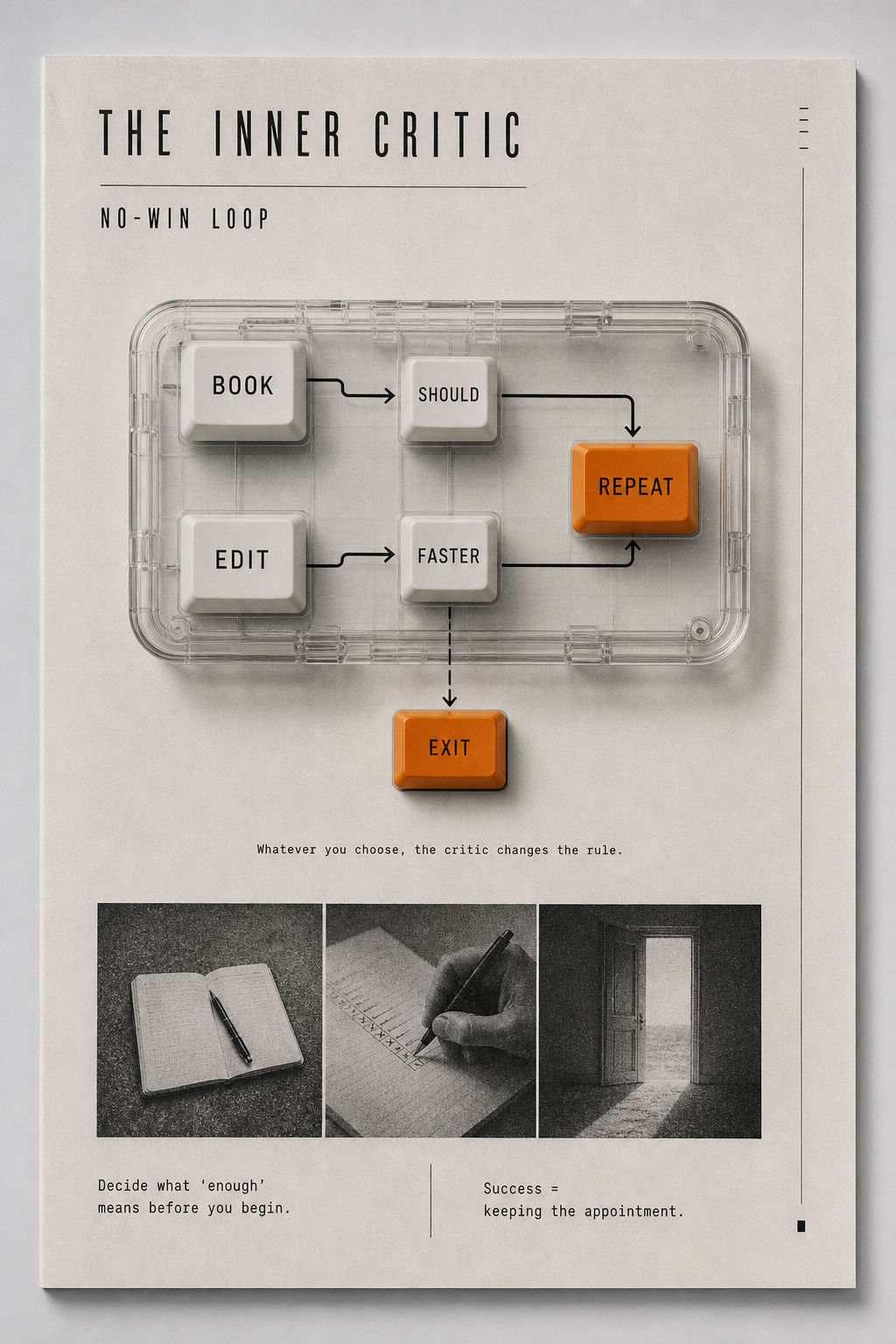
Recognizing this loop helps, but it doesn’t magically silence the critic. This is definitely not easy. I still feel the doubt, urgency, and dissatisfaction. I still have sessions where the work feels too slow or where another task seems more important.
What I’m learning is that I don’t need to defeat the inner critic. I need to stop letting it act as both commentator and referee.
My antidote is to decide what counts before I begin.
I choose one observable promise: work on the book for 45 minutes, edit three pages, or stay with one chapter until the timer ends. Then I write it down, set the timer, and begin.
Most importantly, I lock the rule.
When the session ends, I don’t ask whether I moved fast enough, produced enough, or chose the perfect task. I ask one question: Did I keep the appointment I made with myself?
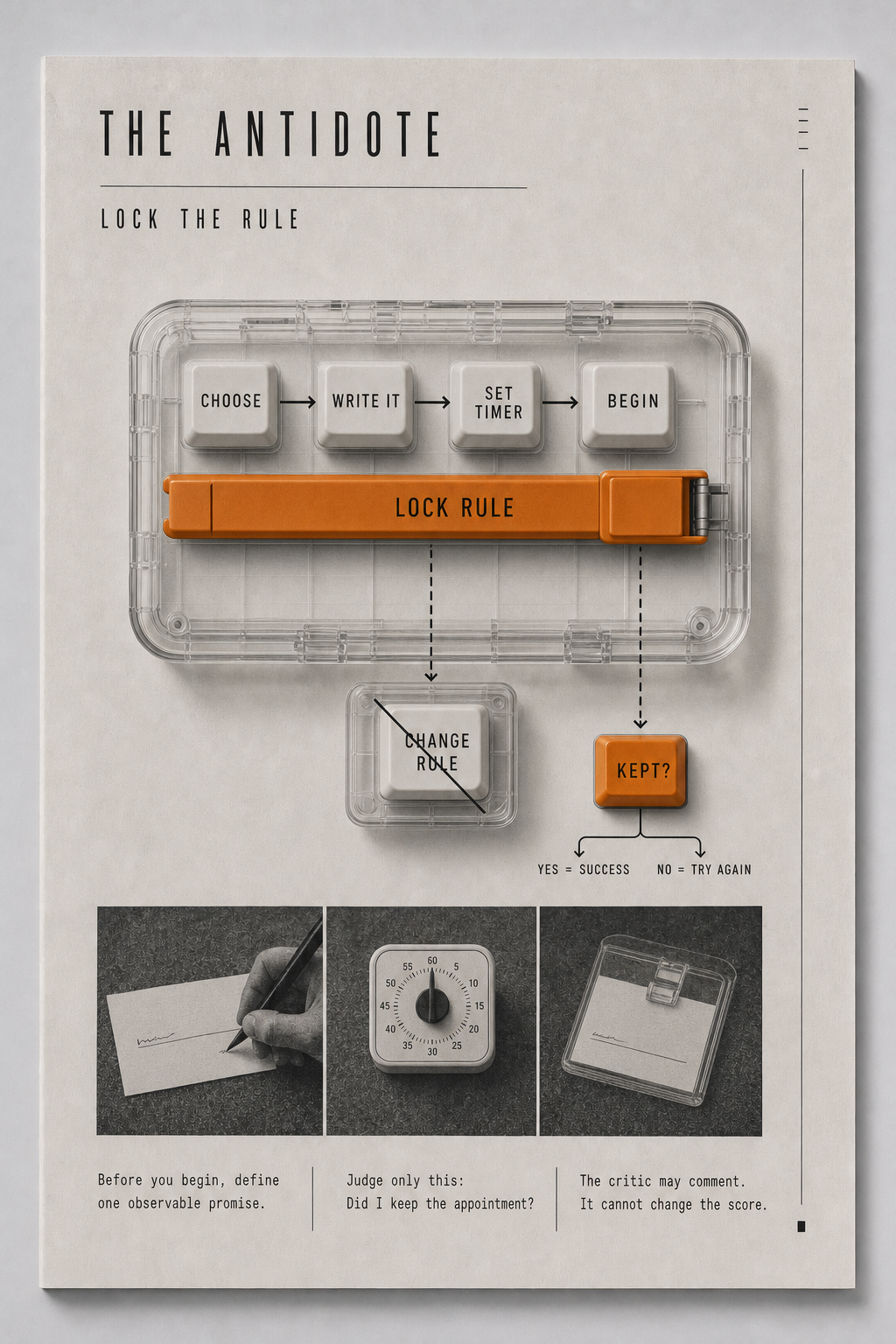
The critic is still allowed to comment. It can say the session should have been longer or the work should have been better. But it cannot retroactively change the agreement.
If I kept the appointment, the session counts as a success.
If I didn’t, that isn’t proof that I’m failing. It is simply information I can use when making the next agreement.
This practice isn’t about lowering my standards. It is about creating a fair relationship with myself—one where the rules remain stable long enough for trust, attention, and meaningful work to grow.
The inner critic may never become completely quiet. But it doesn’t get to move the finish line anymore.