The Long Blog Post: KING OF THE BUTTERFLIES — My Documentary Is Now Free on YouTube
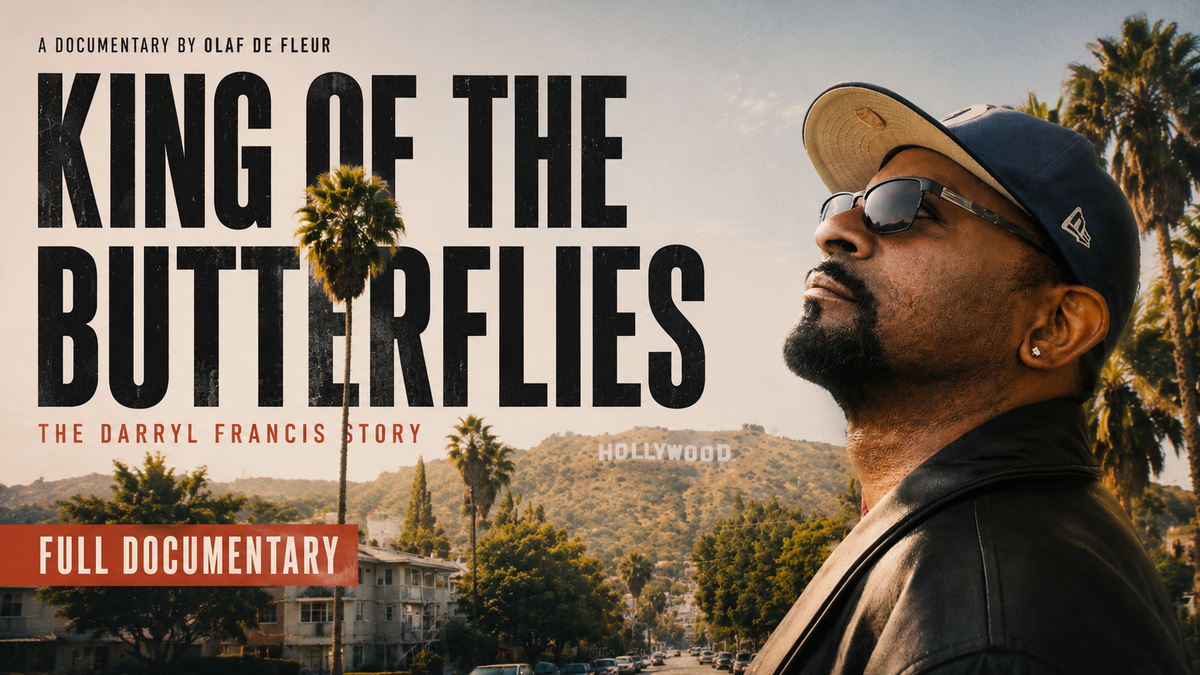
Some films begin with an idea. Others begin with a person you cannot forget.
I’ve now released my documentary KING OF THE BUTTERFLIES in full on YouTube. The film follows Darryl Francis and his attempt to reclaim his life through writing after spending much of his adulthood trapped in the consequences of wrongful incarceration.
It is a film about injustice and trauma, but it is also about humor, friendship, family, imagination, and the extraordinary difficulty of beginning again.
Most importantly, it is about Darryl.
MEETING DARRYL
I first met Darryl through my manager Danny Sherman in 2012.
By then, Darryl had already lived several lives.
Growing up in South Central Los Angeles, he was a funny and imaginative young man who loved his family and his high-school sweetheart, Tonya. He had managed to stay away from much of the gang culture surrounding him and had enlisted in the Army, hoping it would lead to an education and a different future.
Then a trip to a hamburger stand with a friend changed the direction of his life.
Darryl was accused as an accessory to an armed robbery and murder he had not planned. Faced with the possibility of an enormous prison sentence, he accepted a plea agreement. He entered the criminal-justice system as a frightened teenager and emerged carrying injuries that would follow him for decades.
Prison did not simply take away his freedom. It changed his relationship with his family, his body, his sense of safety, and eventually his ability to imagine a future.
THE LETTERS
Writing became one of Darryl’s first paths back to himself.
While incarcerated, he began sending letters home. On the page, he could express things he struggled to say aloud. He could reconnect with his humor, his family, and the person he had been before prison.
He also began inventing letters supposedly written by his mother. They were fictional, playful, and very funny. She could never quite remember her own son’s name, and every new letter became another opportunity for Darryl to entertain the people around him.
He read them to prisoners and guards. For a moment, the walls disappeared.
That humor mattered. It was not denial. It was survival.
Darryl’s imagination allowed him to create a private space that prison could not completely control. Even in an environment designed to reduce a person to a number, writing gave him a voice—and an audience.
Eventually, he began writing a screenplay called Tow Truck.
That screenplay became the original working title of this documentary. More importantly, it gave Darryl a reason to believe that the story of his life might become something other than a record of what had been done to him.
FREEDOM IS NOT A SINGLE MOMENT
We often tell stories about prison as if freedom happens the instant somebody walks through the gate.
Darryl’s experience was more complicated.
He returned to the outside world carrying habits and fears created by incarceration. Ordinary situations could feel dangerous. Isolation could feel safer than openness. The people who loved him were waiting, but accepting that love was not always easy.
There were relapses, returns to prison, periods of depression, and years when stability seemed possible only briefly.
But there were also moments of genuine recovery.
Darryl found support through sobriety programs. He reconnected with Tonya. He cared for his mother as her health declined. He cooked for people, made them laugh, and continued to write.
His progress was never a straight line. That became essential to the film.
I did not want to tell a simple story in which one creative breakthrough magically repairs decades of damage. Writing could not erase Darryl’s past. It could not return the years he had lost or remove the trauma he carried.
But it could give shape to his experience.
It could help him speak.
And sometimes, sitting down and writing a single sentence was its own kind of victory.
MAKING THE DOCUMENTARY
From the beginning, I knew this story needed a form that reflected Darryl’s imagination.
King of the Butterflies combines intimate observational documentary with staged and imagined scenes. These sequences are not there to manufacture reality. They allow us to enter memories and emotional spaces that cannot be captured through a conventional interview.
Darryl’s past is always present. A room can become a prison cell. A sound can open a memory. A moment of humor can sit beside something deeply painful.
The visual language of the film grew from that tension.
We wanted the audience to feel the difference between physical confinement and the freedom of imagination. Darryl could be restricted by walls, institutions, addiction, and memory, yet his mind continued to create stories.
That contradiction became the heart of the film.
The documentary was made with the help of many people who believed in Darryl and the importance of his story.
Ragnar Santos served as producer and cinematographer. Our executive producers included Margret Jonasdottir and Danny Sherman, the person who first introduced me to Darryl. Julia Sandberg and Jeffy Lucky contributed to the early filming, my brother Benedikt Johannesson at DIT Iceland supported the technical work, Craig Jackson created the film’s sound world, and Bijo Robert Johano joined us as a producer.
Films like this are never made by one person. They depend on trust—especially the trust of the person allowing us into his life.
I remain deeply grateful to Darryl, Tonya, and their family for giving us that trust.
WHY “KING OF THE BUTTERFLIES”?
A butterfly is an obvious symbol of transformation, but transformation is often described too neatly.
The caterpillar disappears. The butterfly emerges. The past has been left behind.
Human beings do not change that way.
We carry earlier versions of ourselves with us. Recovery does not mean becoming untouched. Freedom does not mean forgetting confinement. Transformation can be slow, incomplete, painful, and full of reversals.
Darryl’s strength is not that he escaped every part of his past. It is that he continued trying to create a future while carrying it.
For me, that is where the title lives.
The “king” is not a man who has conquered everything. He is a man still searching for the courage to sit down, face an empty page, and write his own name.
WATCH THE COMPLETE DOCUMENTARY
King of the Butterflies runs approximately 80 minutes and is now available to watch completely free on the Icelandic Film Bakery YouTube channel.
I hope you will watch it. And PLEASE SUBSCRIBE (i'm doing an experiment with Youtube of giving away lessons and films - it stands and falls with subscribers) :)
Not because Darryl’s story offers an easy answer, but because it asks difficult and necessary questions.
How much of a person can an institution take away? What remains after decades of confinement? Can imagination become a form of freedom? And when somebody has been defined by the worst years of his life, who gets to write what comes next?
For Darryl, the answer begins with a page.
Subscribe to Olaf de Fleur:
Subscribe on YouTube