The Creative Case for Doing Absolutely Nothing
Some ideas belong in an unfinished state. Crooked. Half-formed. Still breathing.

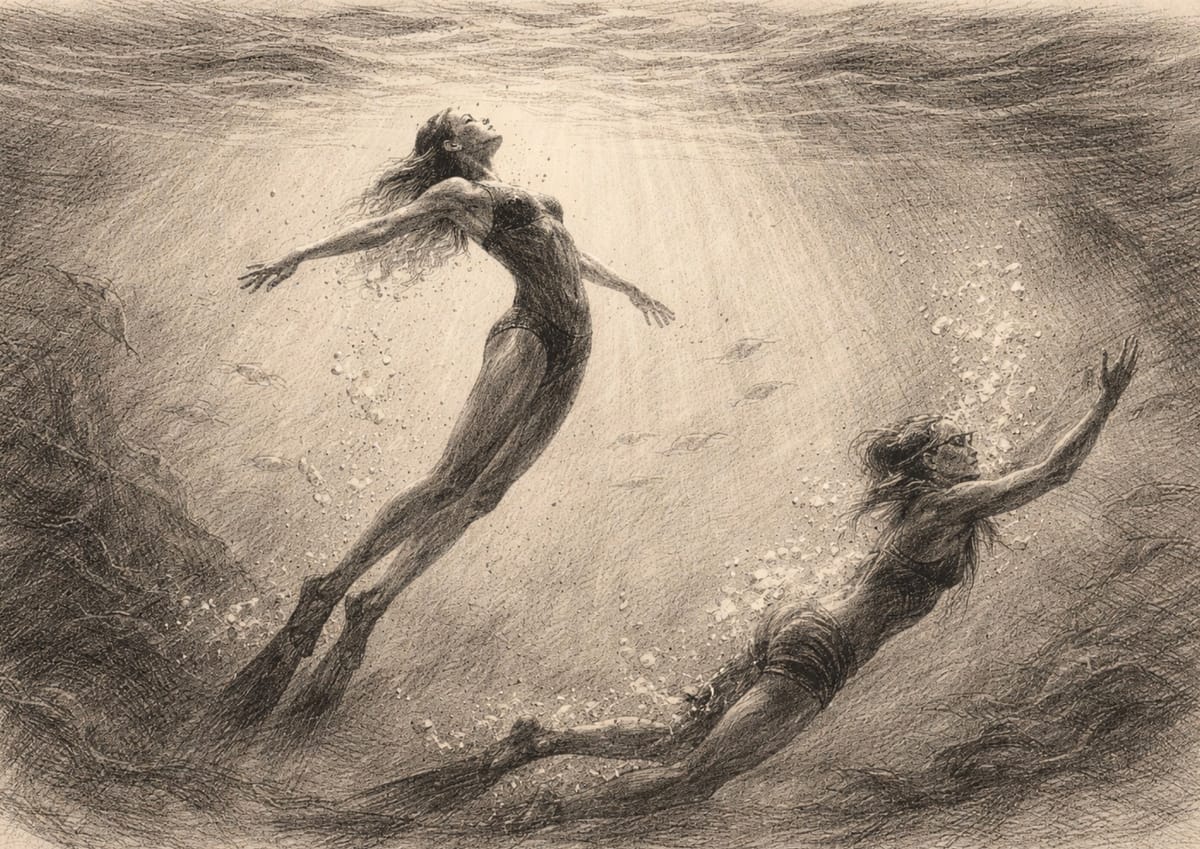
Letting go isn't quitting. It's a feature, not a bug.
There's a productivity framework nobody talks about, because it looks, from the outside, like laziness. It involves no apps, no Pomodoro timers, no second-brain systems. It requires only one thing: releasing your grip on the problem entirely.
Call it floating.
Not abandoning the work. Not rage-quitting the doc or ghosting the deadline. Something more precise — a deliberate loosening. The project stays. The ideas stay. You just stop forcing them into shape. You let the whole thing drift, briefly, in open water.
This sounds soft. It isn't.
The Counterintuitive Mechanics of Letting Go
There's a reason free divers train themselves to do less, not more. Fight the water, and the water wins. The body burns oxygen faster, panic sets in, instinct overrides skill. But release the urge to control every motion? The body finds its own rhythm. Buoyancy does the work.
Creative cognition operates on similar physics.
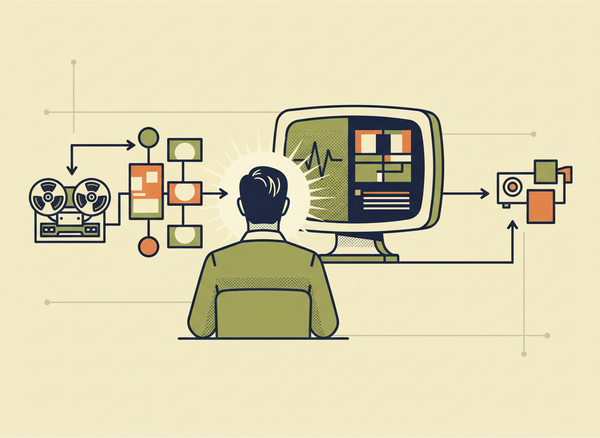
When you stop forcing a problem from the top down — brain to fingers to output — something shifts. The processing doesn't stop. It relocates. Breath. Body. Then thought. The bottom-up direction is slower, stranger, and often significantly more useful.
This isn't woo. Default Mode Network research has spent two decades documenting what happens when the brain stops tasking: associative thinking fires up, pattern recognition runs in the background, and solutions surface that directed effort never finds. The idle mind isn't offline. It's running a different process.
Floating is how you attempt to access it.
An Old Storytelling Idea That Applies to Everything
Latin has a phrase for it: in medias res. Into the middle of things.
In medias res
- Latin: In medias res
- English: Start in the middle of the action
- Babylanguage: Start the story in the middle
It's a classical narrative technique that screenwriters still reach for constantly. The story doesn't start at the beginning. It drops you into a moment already in motion. Something is already happening. The water is already moving. You figure out the context as you go.
The interesting thing is how closely this mirrors the actual experience of creative work — particularly writing, particularly the kind that resists being planned.
You think the job is to design the whole journey from the shore. Stand back, survey the landscape, plot the cleanest path between two points. But anyone who has spent serious time on a screenplay, a novel, a product — anything with real complexity and genuine unknowns — knows the shore is an illusion. You're already in the water before you realize it.
In medias res isn't just a technique for the audience. It's the actual condition of the maker.
Some ideas belong in an unfinished state. Crooked. Half-formed. Still breathing. The pressure to resolve every thought into a publishable insight is its own kind of creative drag — the compulsion to stand on the shore and explain things to yourself before you're allowed to wade in.
Sometimes the most honest thing is to already be in the middle of the water, still figuring out which way the current runs.
The Direction of the Current
Here's what floating actually produces, eventually: orientation.
Not a map. Not a plan. Just a gradually clearer sense of which way things are moving. Where the resistance is. Where it isn't. The story reveals itself not because you forced it open, but because you stayed present long enough to notice it.
That's the whole move. Stop demanding that the work explain itself on your timeline. Float in the middle of things for a while. Look around.
The current is already there.
Your job is just to T R Y to understand where you are. Sometimes that's enough.